Materials & Products
Choosing Natural Materials for Sustainable Storage Baskets
Which natural material suits which basket? Cotton rope, paper rope, bamboo, seagrass and felt compared by function, durability and the failures buyers hit.
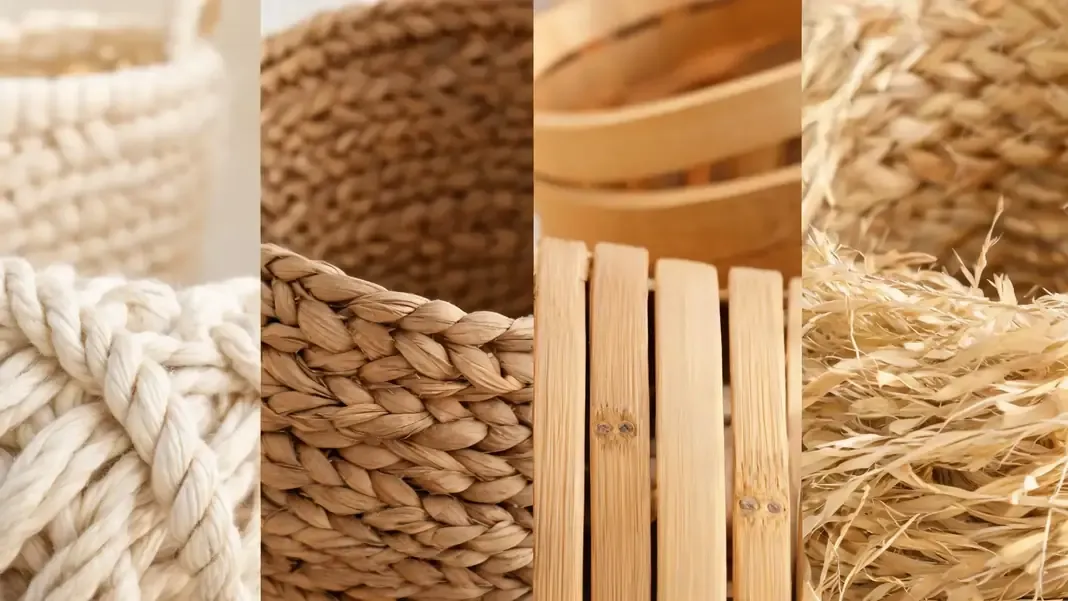
Material choice decides three things at once: how the basket looks, how long it lasts, and what your customer has to do with it when they are done.
The same woven shape in cotton rope, paper rope, seagrass or bamboo behaves differently in a bathroom, in a container, and in a returns process. This page covers what each material is good at, how to choose by function instead of by look, and where natural materials actually fail.
What Natural Materials Do for an Order
Three commercial reasons buyers keep coming back to natural fibres.
They carry a higher retail price. A natural woven basket reads as considered in a way moulded plastic does not. That supports the price you need to run a margin on a low-volume design.
They photograph well. Texture catches light. For any brand selling through Instagram, Pinterest or a lookbook, that is a real advantage over a smooth surface.
They suit the customer who is already buying this way. Buyers looking for a natural fibre basket are usually already filtering for it. You are answering a request rather than arguing for one.
None of that is new. What changes between materials is the risk.
The Materials and What Each One Is Good At
Not a specification sheet. This is the short version of what each material does well and where it stops working.
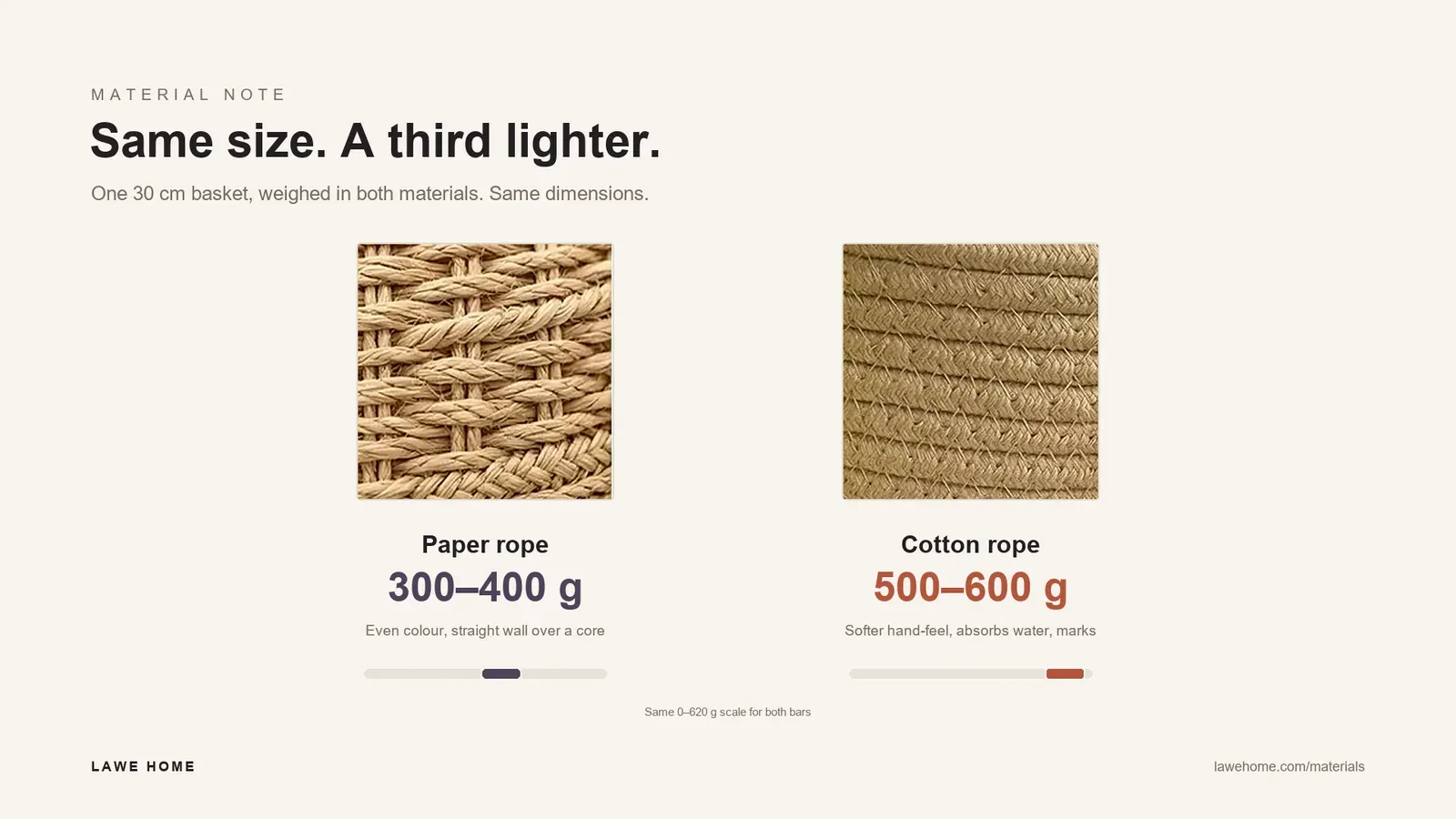
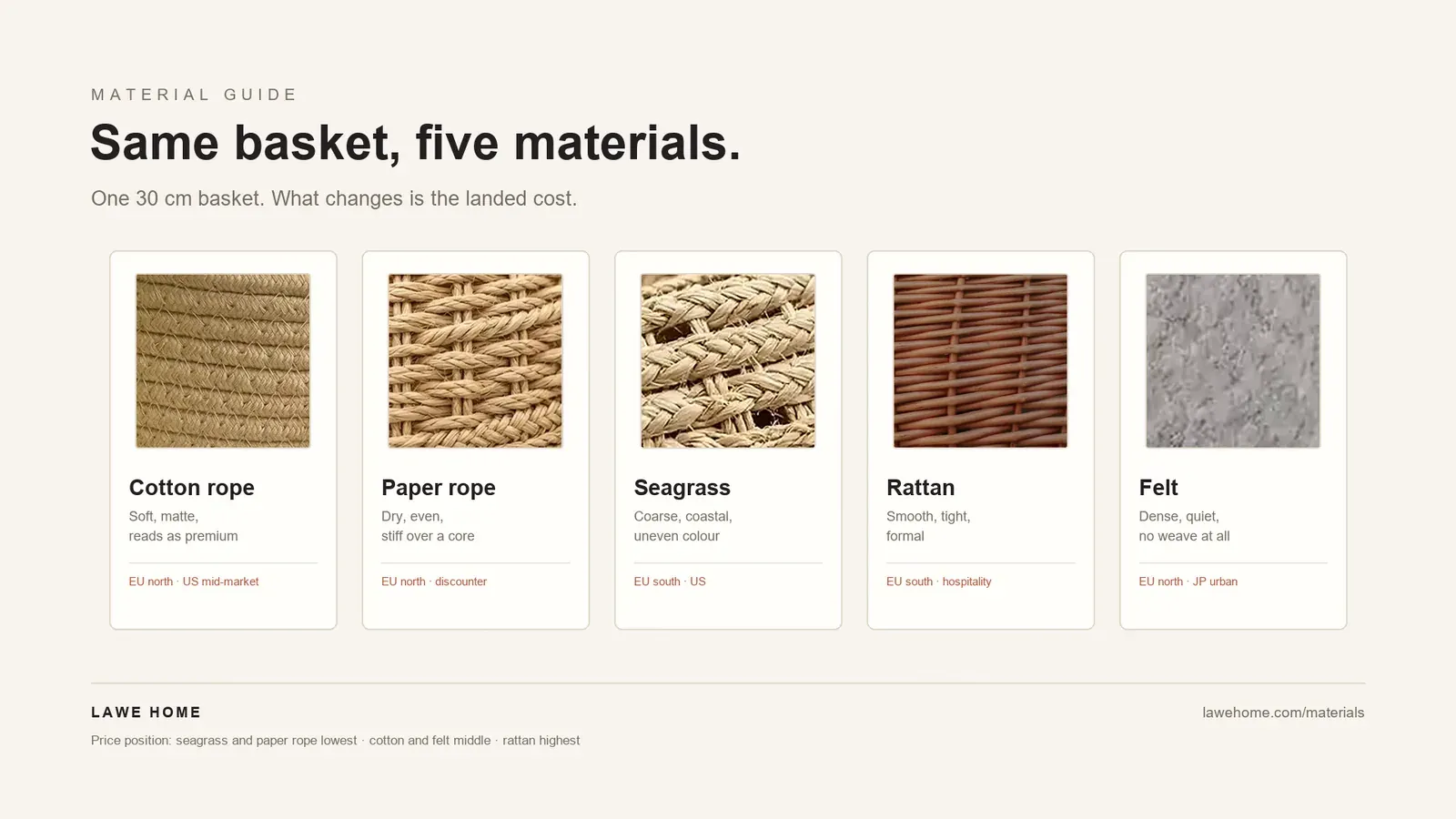
Cotton rope. Soft, dense, holds a shape. The best all-rounder for storage baskets, laundry baskets and anything that gets handled daily. It costs more at the same volume, so it usually shows up in mid and upper price points.
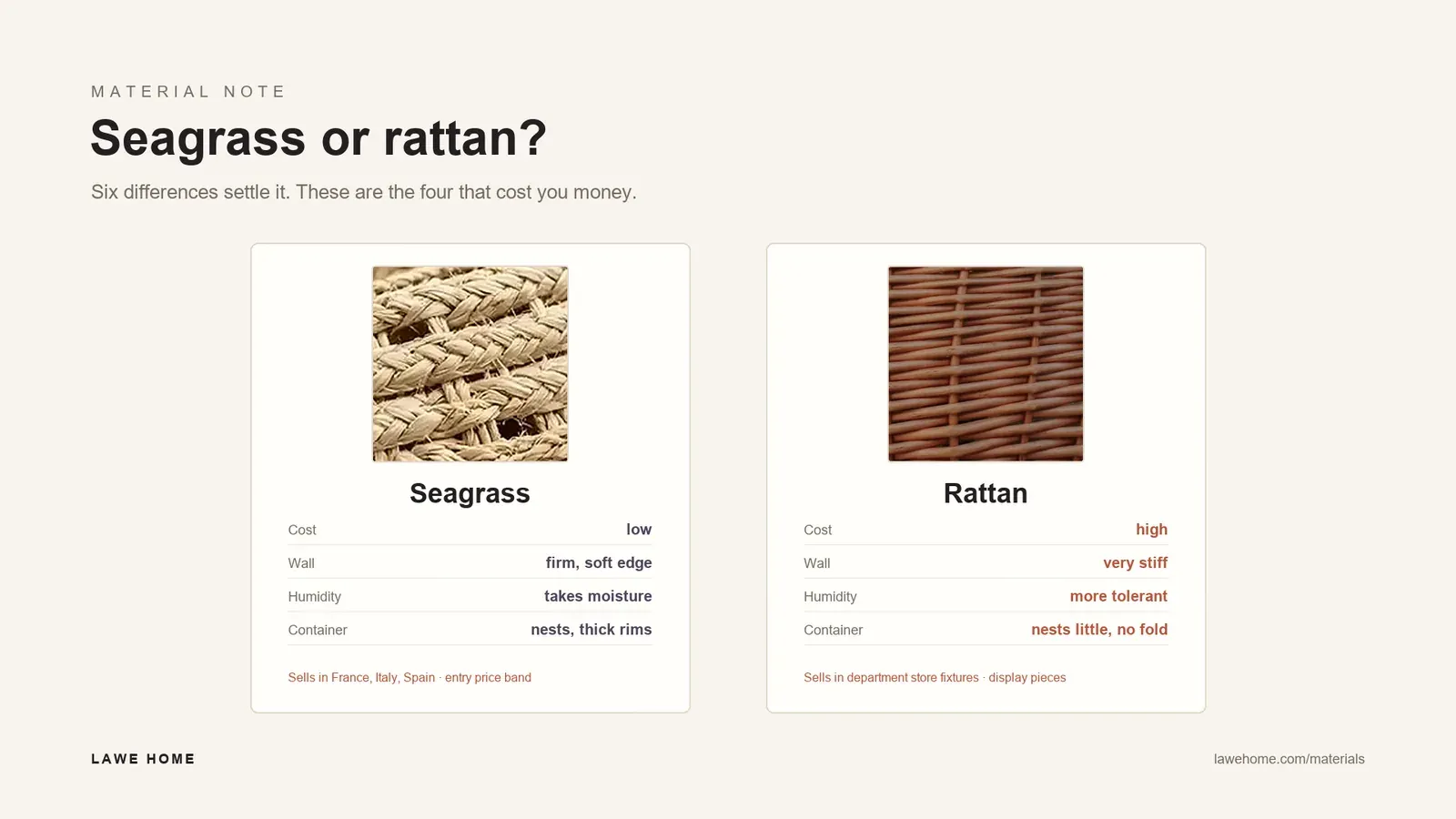
Paper rope. Light, with a clean woven look. Lower cost per unit than cotton at similar appearance, and a common request from European buyers. It is more sensitive to moisture and to pressure than cotton.
Seagrass. Firm and structured with strong natural colour variation. Good for large floor baskets and planters. Each piece varies slightly, which is a feature in retail and a problem in a matched set.
Bamboo. Where natural fibre meets structure. Best for frames, laundry hampers and anything that needs to stand square under load.
Felt and fabric. Not woven, but they belong here. Foldable, easy to ship, soft in a nursery or wardrobe. Fast to pack flat, which matters for freight.
Natural fibre blends. Mixed yarns let you balance cost and handfeel. Read the blend carefully. A small percentage of a synthetic yarn can change how the product behaves at end of life.
Choose by Function, Not by Look
The failure mode is choosing a material from a photo. Start from the job.
The job | Material that usually works |
Handled daily, needs to hold shape | Cotton rope |
Large floor basket, decorative | Seagrass |
Laundry hamper, needs to stand square | Bamboo frame, or a rigid lining |
Wardrobe or shelf, ships flat | Felt or fabric |
Cost-led range, mid appearance | Paper rope |
Nursery or kids room | Felt, or a tight-weave cotton |
Two rules sit under that table.
Weight follows function. A basket that gets lifted every day is a different product from one that holds blankets in a corner. The first needs structure, the second needs volume.
Damp beats every material. Bathroom, laundry room and utility room products have the hardest life. If a product will live in a damp room, the construction matters more than the fibre.
What Sustainability Actually Means on an Order
"Sustainable" is used loosely in homeware. Four things are worth checking, and only one of them is the fibre.
Durability is the strongest claim you can make. A basket used for eight years is a better argument than a compostable one replaced every eighteen months. Build for the second year, not for the launch photo.
A blend is harder to recycle than either fibre alone. Mixed yarns and mixed-material constructions are the hard part of any waste stream. If end-of-life matters to your customer, keep the material list short.
Natural is not the same as low impact. Weaving, dyeing, treatment and freight all sit inside the number. We do not publish a carbon claim, because we cannot verify one, and an unverified number is worse than none.
Packaging counts too. A natural basket in a plastic-heavy carton is a mixed message at the doorstep. This is covered in our PPWR checklist for buyers.
There is no single sustainable option. There is a set of choices that need to line up.
Where Natural Materials Go Wrong
Four failures worth designing against from the start.
Moisture and mould. Natural fibres hold humidity. A sealed carton crossing the equator with no ventilation and no desiccant is how a claim starts. Ventilation, adequate desiccant, and a carton that does not sit in the rain are cheaper than replacing a shipment.
Warping in transit. A large seagrass or bamboo piece under uneven stacking will distort. Corner protection and correct stacking at the bottom of the pallet prevent it.
Colour variation between lots. Natural fibres vary between harvests. Two production runs months apart can differ. If your range sells as a matched set, say so before production, because it changes how the material is selected.
Shedding and pilling. Some yarns shed fibres for the first weeks. For a nursery or a product used near clothing, confirm the behaviour on a sample before you commit.
All four are visible on a sample if you look for them. None of them are visible in a product photo.
FAQ
Is cotton rope better than paper rope?
Not better, different. Cotton is softer, denser and holds shape better. Paper rope is lighter and cheaper at a similar appearance. Choose by where the basket will live.
Which natural material is most durable?
Bamboo for structure, cotton rope for daily handling. Both outlast seagrass under regular use, which is a look-led material.
Do natural fibre baskets need special care?
Keep them dry, wipe rather than soak, and keep them out of direct sun to slow fading. Most care instructions are simply a moisture instruction.
Can you match a colour across repeat orders?
Within a reasonable range, yes, and we will tell you the range before you order. Exact matches across harvests are not realistic in natural fibre, which is worth knowing if your range is sold as a set.
Do natural fibre baskets smell when new?
Some do, for a short period, depending on the fibre and how it was treated. It fades with air. If your product goes straight from a carton to a customer, check this on the sample and put a line in your care instructions.
How do I compare two samples from two suppliers?
Put them side by side, empty, on a flat surface. Check whether the base sits flat, whether the walls hold their shape when empty, and how the handle feels loaded. Those three tell you more than appearance.
Do you work with recycled fibres?
We work with natural and blended yarns, and we will tell you what a specific material actually contains. We do not publish recycled content figures we cannot verify for a given batch.
Related products
Working on a natural fibre range? Send the product, the market and the target price. We reply within 24 hours with material options and what each one costs. → contact us · Or browse our collections.
Sampling in any of these materials runs 7 to 10 days after design confirmation. More on how a project runs is in our OEM and ODM development guide.