Quality & Craft
Inside a Pre-Shipment Inspection for Woven Storage Baskets
What we check before a woven basket order ships: sampling, size, weight, structure, stitching and colour. Plus what the inspection report records.
Our inspection starts with the sample you approved, not with the cartons.
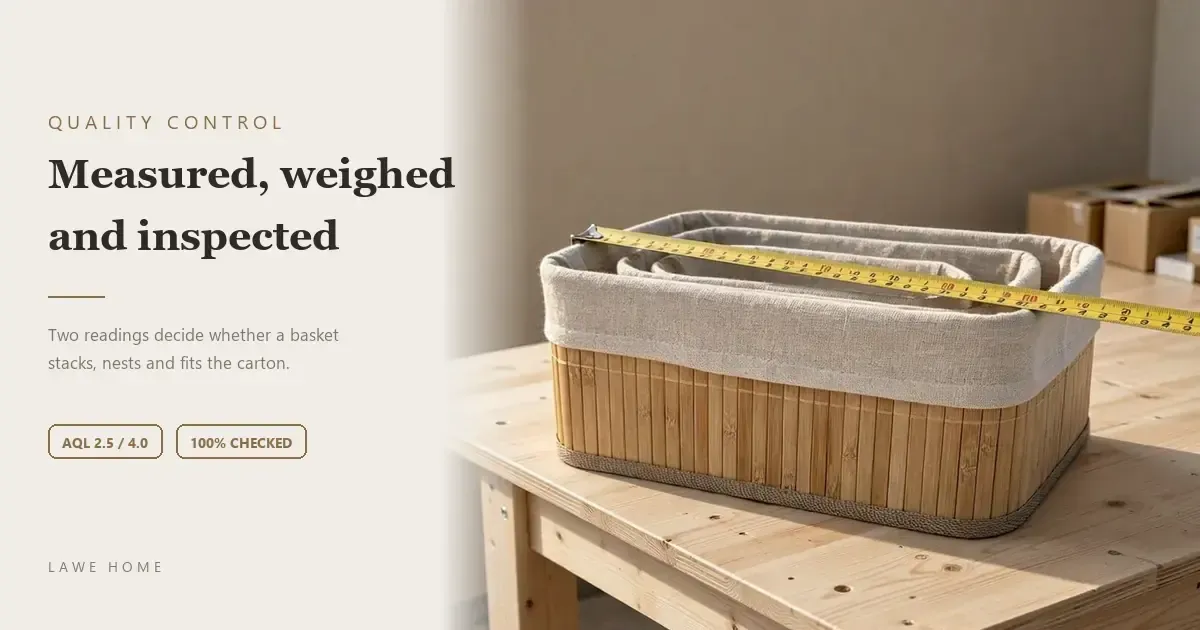
Before an order ships, every unit is measured and weighed. A sample is then checked for structure, stitching and appearance. What follows is the order we work in, what each step is measured against, and what happens when something fails.
How the Inspection Is Ordered
Everything that can be read off an instrument is checked first. That is a practical choice, not a formal one. A number on a tape does not depend on anyone's taste. Neither does a number on a scale. Those are also the two readings buyers and suppliers argue about longest.
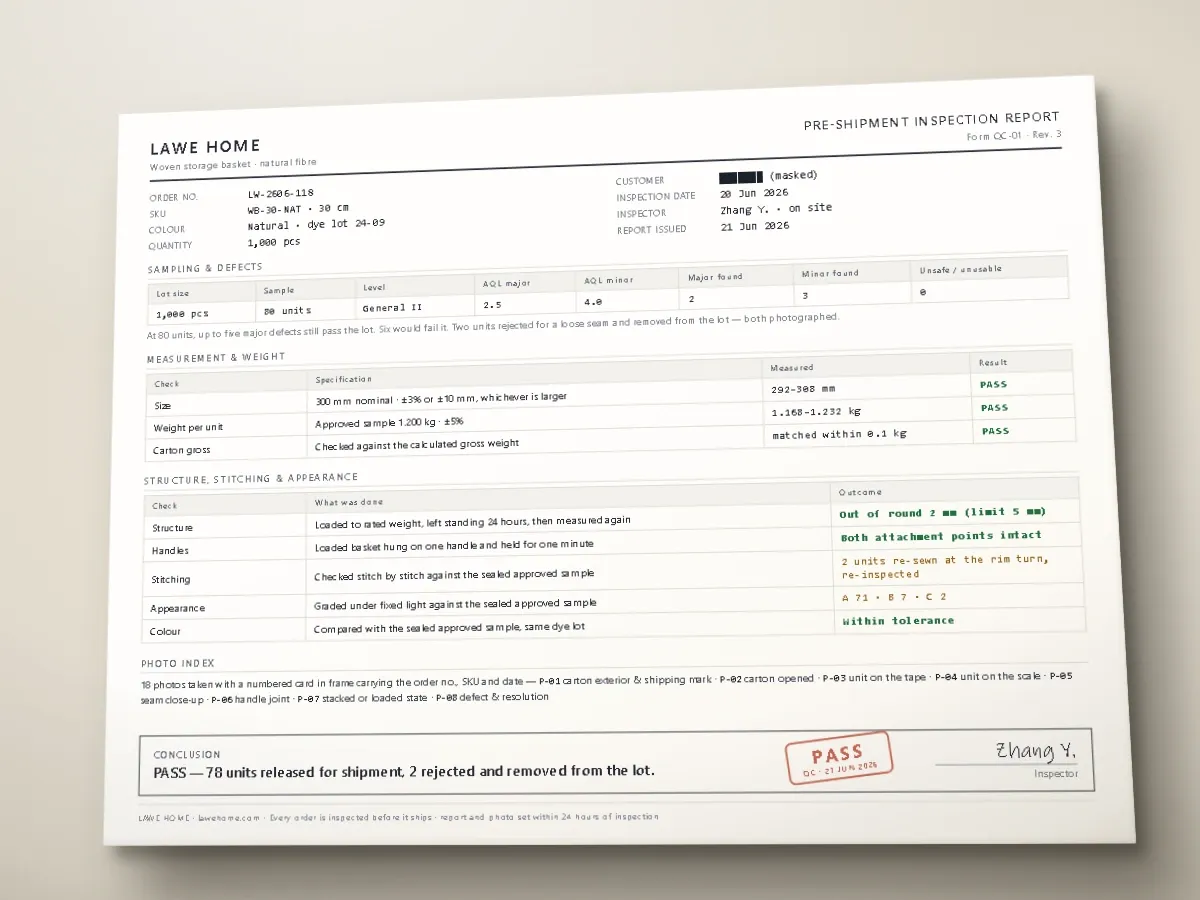
The lot size sets the sample. A 1,000-piece order under general inspection level II gives 80 units to inspect. We work to AQL 2.5 for major defects and 4.0 for minor ones. Anything that makes a basket unsafe or unusable has zero tolerance. At 80 units, five major defects still pass the lot. Six fail it.
Measurement and weighing come next, then structure and stitching, then appearance. Appearance is graded last and always against the sealed approved sample. Never against the inspector's memory of the colour, which is how most arguments start.
Failures are handled in three steps: mark, fix, re-check. A basket that fails is tagged and pulled out. It does not go back into the stack on a promise.
Measurement, Weight and Tolerance
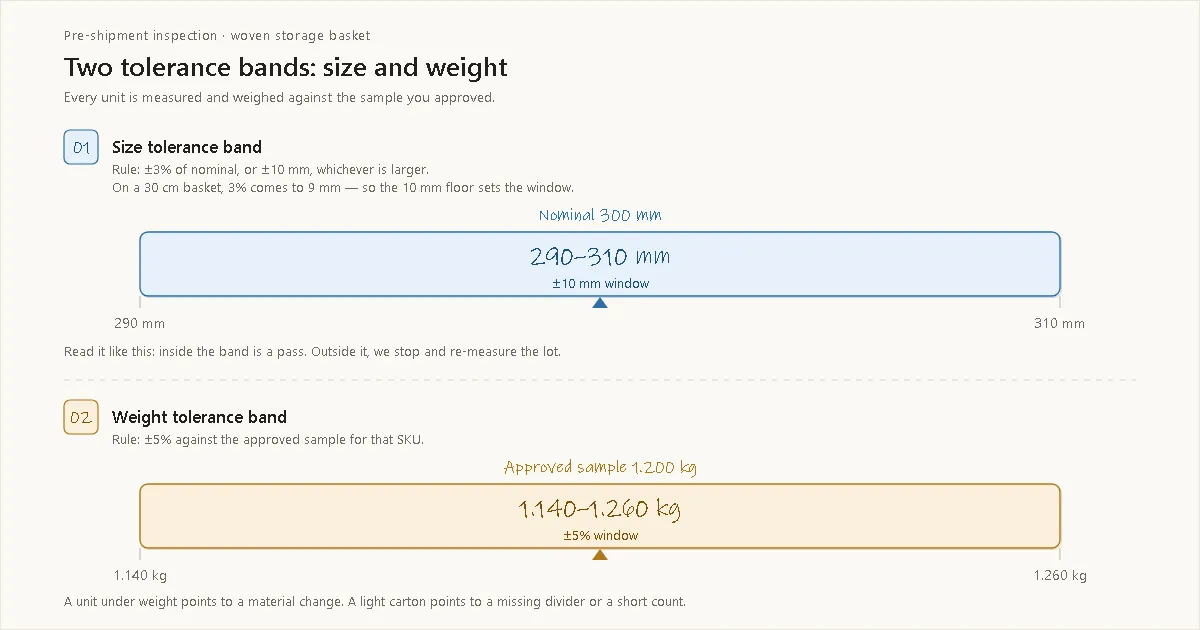
Every unit is measured across the top and for height. On a woven basket we work to ±3% of the nominal size, or ±10 mm, whichever is larger. A tighter specification wins if you have one.
A 30 cm basket therefore has a 10 mm window, because 3% comes to 9 mm and the 10 mm floor takes over. That sounds generous until you stack six of them. The window becomes 60 mm of drift, and the carton is sized for the nominal height. On nesting sets it is tighter. The middle size has to sit inside the large one and hold the small one. Move it 10 mm and the set stops nesting.
Every unit is also weighed, to a ±5% band against the approved sample. Weight is the fastest signal of a material change, and it shows up before anything is visible. A rope moving from 4.0 mm to 4.2 mm adds about 10% to the weight of the same basket. In a photo, the two look identical.
The carton is weighed as well, and checked against the calculated gross weight. A carton that comes in 200 g light usually means a missing divider or a short count, not a lighter basket.
When a unit falls outside tolerance we stop and re-measure the lot. If the drift sits in one batch of material, the whole batch is held for rework rather than sorted through.
Need samples before you commit? Sampling takes 7–10 days after design confirmation, and a physical sample is what the inspection is measured against later. → start a custom project
Structure and Stitching
Structure is tested on the basket, not on the drawing. We load a unit to the weight it is rated for. It stands for 24 hours, then we measure it again. A basket that has gone more than 5 mm out of round, or whose base has sagged, fails.
Handles get their own test. We hang the loaded basket by one handle and hold for a minute, then look at both attachment points. Handle failure is the complaint that reaches a retail customer fastest. It is almost always a stitching problem, not a rope problem.
Stitching is checked stitch by stitch against the approved sample. We look at density, tension and where the seam turns. Two places fail first. One is the joint between the body and the handle. The other is the final turn at the rim, where the machine runs slowest.
A skipped stitch can be repaired. Loose stitching across a full seam cannot, and the unit is rejected. Repaired units are re-inspected and photographed, so the photo record shows the fix rather than hiding it.
Appearance Grading and What Cannot Be Fixed
Grading happens under a fixed light, not the ceiling of the room. Each unit is compared with the sealed approved sample and marked A, B or C. A goes to retail. B is usable but needs a decision from you. C is rejected.
Colour is the most common argument and the hardest to win. A repeat order will rarely match the first one exactly, because the rope is dyed in a different bath. That is why colour is always compared with the sealed sample. It is also why we ask for the same dye lot on a repeat order.
Two defects can be worked on and two cannot. Deformation can often be corrected by re-shaping and resting the basket. A skipped stitch can be re-sewn. Colour difference cannot be fixed, and neither can an odour that comes from material that was not dry before weaving.
Every failure ends in one of three places: rework, a written concession from you, or rejection. There is no fourth option where the goods ship first and the discussion happens later.
Photos and the Report
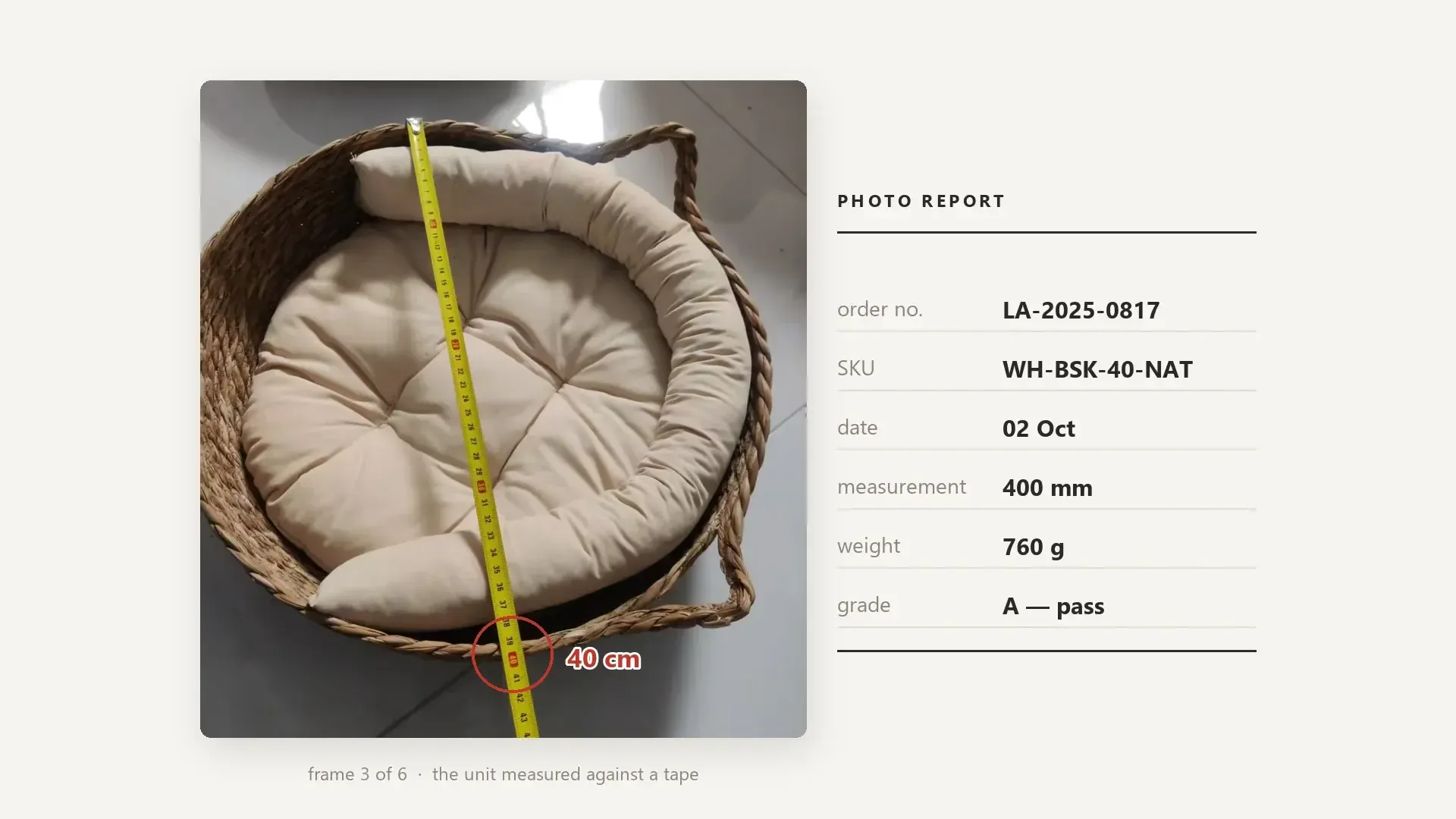
Photos are taken with a numbered card in frame. The card carries the order number, the SKU and the date. A photo can never be lifted from a different shipment.
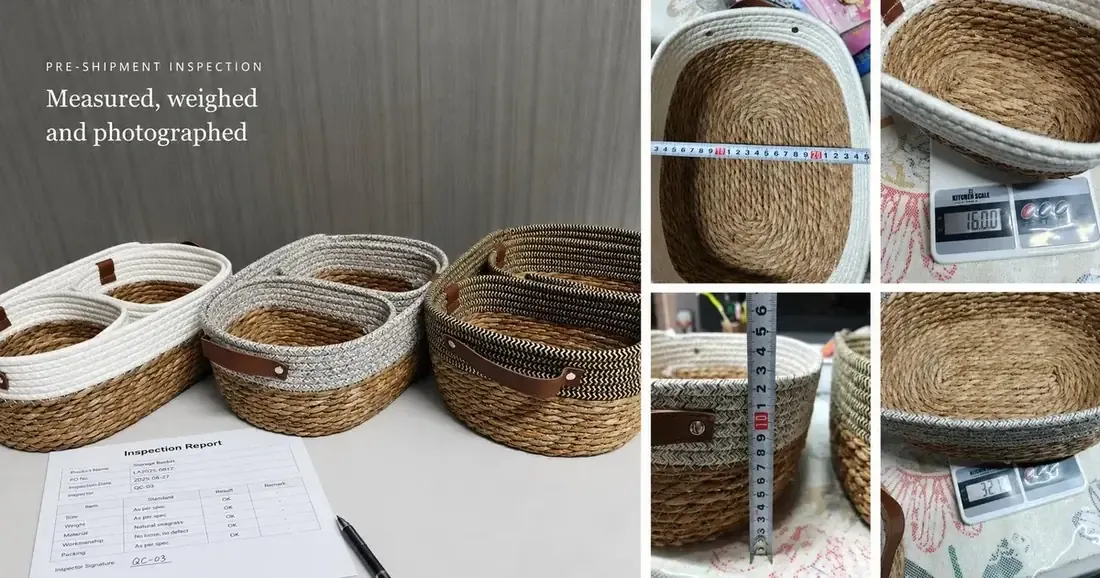
The standard set covers:
- the carton exterior and the shipping mark
- the packed carton opened
- the unit measured against the tape
- the unit on the scale
- the seam close-up and the handle joint
- the stacked or loaded state
- any defect, with how it was resolved
The report itself is short and factual. It records:
- order number, SKU, colour, quantity, inspection date and inspector
- lot size, sample size and the AQL applied, with defects listed by class
- measurements against specification, and weights
- structure result, stitching result and appearance grade
- the photo index
- a closing line: pass, rework and re-check, or hold
We inspect every order rather than a random one, and the reason is arithmetic. A problem found at the production site costs a few hours of rework. The same problem found at the port costs you a season. The goods are already packed, already booked and already late.
If a supplier's idea of inspection is one carton opened at the end, find that out before you order.
Frequently Asked Questions
Do you charge for the inspection?
No. It is part of how we handle an order, not a separate service line. A third-party inspection company can also be appointed if your own process requires it.
Can our own inspector or a third party attend?
Yes. Tell us which company and we will arrange the timing with the production schedule. Your inspector gets the same access we have.
What happens if the order fails?
It is reworked and re-inspected. Dispatch is delayed until it passes. We do not release a failed lot against a promise to fix it at the other end.
How long does the inspection take?
For a 1,000-piece woven order, one to two days on site. The report and photo set reach you within 24 hours of the inspection.
Does the inspection cover packaging as well?
Yes. Carton marking, unit count, inner packing and the packaging specification are all checked. This connects to the packaging requirements covered in our PPWR checklist for buyers.
Related products
Have a product idea or a target price? Send it over — we'll reply with feasibility feedback and a quote within 24 hours. → contact us
There is more on sampling, ordering and shipping on our FAQ page. You can also browse our collections to see the ranges these checks apply to.